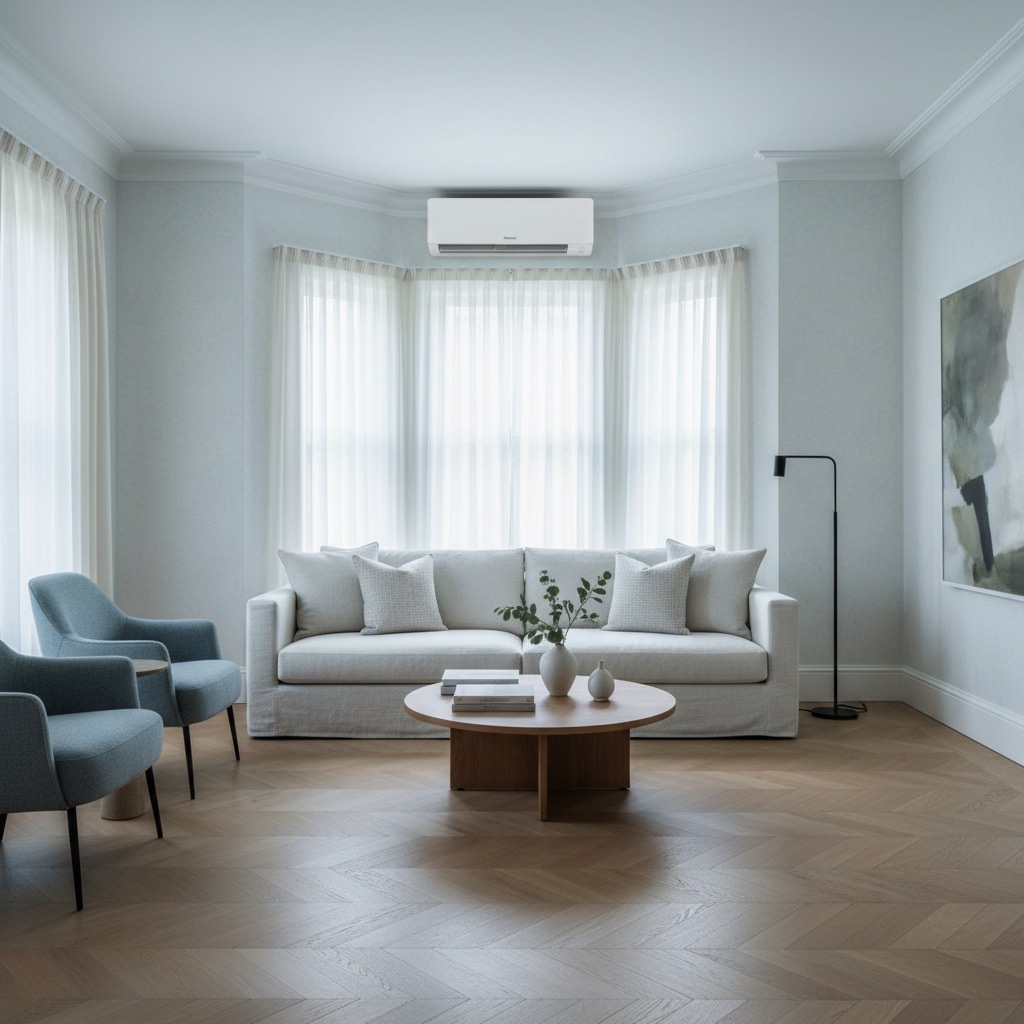
Harpenden houses are lovely to live in for eleven months of the year. Then a heatwave arrives, the loft conversion is still sweltering at bedtime, and everyone remembers that a fan just moves warm air around. If that's what brought you here, here's what actually works, what it costs, and what to check before anyone drills a hole in your wall.
Why Harpenden homes overheat
The town's housing stock was built to keep heat in, not out. The Victorian and Edwardian streets around the station and the common have solid brick walls that soak up heat all day and release it into your bedroom all evening. The 1930s semis and detached houses that spread out from there behave much the same, and many have since gained the classic Harpenden upgrade: a loft conversion.
Loft rooms are reliably the hottest space in the house — heat rises into them, and they sit directly under a sun-baked roof with limited cross-ventilation. If your teenager's bedroom or your home office is up there, you already know.
A properly installed split air conditioning unit sorts this properly — and because it's a reversible air-to-air heat pump, it heats the same room very efficiently in winter too. One thing to flag: the outdoor unit usually goes on an external wall, and if you're in one of the conservation areas around the common, it's worth checking with the council before anything is fixed to the house. A good installer will know the drill.
Check your electrics first
Before pricing units, it's worth a quick look at your fuse board. Plenty of Harpenden's period homes are still running on older consumer units, and a split system — like an EV charger or a battery — wants modern, safe electrics behind it.
This isn't usually a dealbreaker. A consumer unit upgrade is a routine job — typically a few hundred pounds to around a thousand — and any decent installer will assess it as part of the survey rather than spring it on you later. If you're planning solar and a battery as well, it makes sense to sort the electrics once, properly, before any of it goes in.
What it costs
For a single room — that loft conversion, say — a wall-mounted split system typically comes in somewhere around £1,500–£3,000 installed, depending on the unit and how far the pipework has to travel. Cooling more rooms with a multi-split system costs more, but you rarely need to do the whole house; most families cool the two or three rooms that actually get hot.
Running costs are modest — roughly 10–30p an hour depending on the room and your tariff. Our running costs guide has the honest numbers, and the full cost breakdown covers installation in more detail.
If you'd like a price for your actual house rather than a range, ask for a quick estimate and we'll match you with one vetted local installer — not a call barrage, and no chasing.